The Argument for Seasonal Alignment
Seasonal produce carries a straightforward nutritional advantage: items harvested at their natural peak retain higher concentrations of vitamins and minerals compared with produce transported over long distances or stored under refrigeration for extended periods. This is not a contested point in published nutritional research — the degradation of certain heat-sensitive and light-sensitive nutrients during extended cold storage is well documented in peer-reviewed literature on post-harvest physiology.
For the purposes of weekly menu planning in the United Kingdom, seasonal alignment means broadly following what local market suppliers and farm-box delivery services are stocking at any given time of year. In the colder months, that means root vegetables, brassicas, hardy leafy greens, and stored apples. In summer, it means courgettes, tomatoes, peas, and a wider selection of salad crops. The menu adapts to the calendar, rather than imposing a fixed template on every week regardless of what is available.
The practical benefit is not only nutritional. Seasonal produce tends to be less expensive at the point of peak availability, so a menu structured around it tends to be more cost-effective per nutrient unit than one built around imported items. This is a consideration that a cost-per-serving analysis, performed across twelve months of kitchen records, consistently confirms.
"A menu that adapts to the season is not subject to the false constraint of sameness. It is, by its nature, varied."
Constructing the Weekly Inventory
The starting point for any well-structured weekly menu is a working inventory — a record of what is currently in the kitchen, organised by category: proteins (animal or plant-based), carbohydrate sources (whole grains, pulses, tubers), vegetable matter, and condiment or flavouring stores. Before planning the week's meals, the inventory is reviewed. This prevents duplication purchasing and ensures that older items are incorporated before newer ones — a straightforward application of first-in, first-out principle to the domestic kitchen.
Against this inventory, seven days of meals are sketched in outline: three main meals and, optionally, one to two snack points per day. The sketch is not rigid. It is a framework that accommodates the reality of daily life — a meal eaten out, a batch cooking session that yields leftovers for the following day, a delivery of produce that arrives slightly different from what was ordered. The weekly menu is a working document, not a contract.
Nutritional balance is addressed at the week level rather than the meal level. Research on dietary adequacy consistently indicates that looking at nutrient intake across multiple days is a more accurate reflection of habitual eating than evaluating single meals in isolation. This is a practical consideration as well as a methodological one: it removes the pressure to make every individual plate a complete nutritional statement, which can make meal planning unnecessarily complex.

Portion Awareness as a Planning Variable
Portion awareness is one of the more practically relevant concepts in everyday nutrition, in part because it does not require any specialist equipment or technical knowledge. A straightforward approach — using the hand as a reference measure — allows for rough but consistent approximation of serving sizes without the need for scales. The palm indicates a protein portion, a cupped hand a carbohydrate serving, and a flat hand a fat-dense ingredient like nuts or cheese.
When planning a weekly menu, portion awareness is applied during the grocery planning stage rather than at the point of cooking. Quantities of each ingredient are estimated by multiplying the intended serving size by the number of meals in which that ingredient appears. This produces a shopping list that is calibrated to actual household consumption, reducing both under-buying (which leads to mid-week shortfalls) and over-buying (which generates food waste and distorts the intended meal structure).
A common observation in published dietary guidance is that portion sizes in the home tend to increase progressively over time as familiarity with a recipe grows. The practised cook inadvertently adds more pasta, pours a larger measure of olive oil, or serves a deeper bowl than the recipe intended. The weekly menu planning stage, if it includes explicit portion notation, provides a corrective reference point that resists this incremental drift.
- 01 Seasonal produce alignment supports nutritional completeness without requiring supplementation or specialist sourcing.
- 02 A weekly inventory review, conducted before menu planning, reduces duplication and ensures ingredient rotation.
- 03 Nutritional balance is best assessed at the week level, not the individual meal level, according to published dietary research.
- 04 Portion notation during the planning stage counteracts the progressive enlargement of serving sizes that occurs with repeated preparation of familiar dishes.
- 05 A flexible weekly menu framework outperforms a rigid daily schedule in practical household application.
The Fibre and Colour Composition Standard
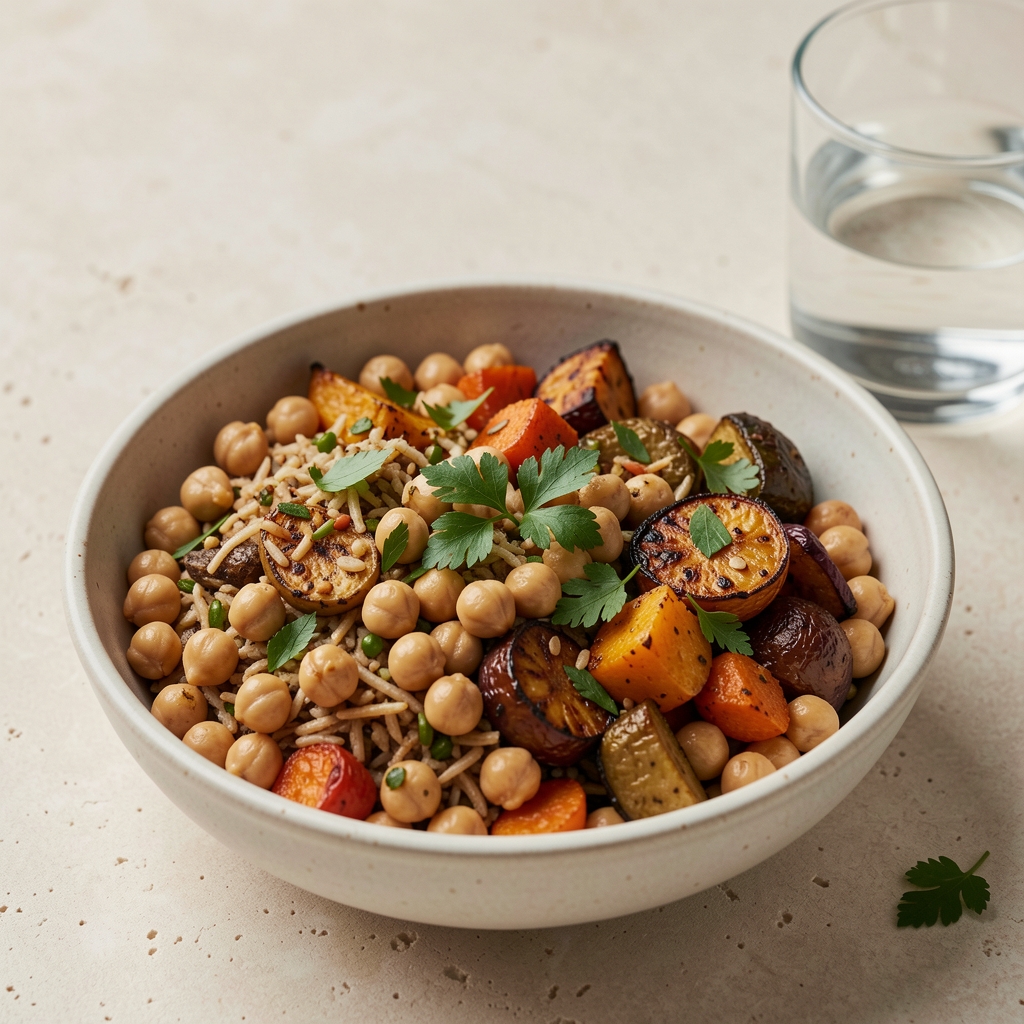
A well-documented proxy for dietary adequacy in the everyday nutrition context is the visual composition of the plate: a diverse colour range across vegetables and fruits reflects a proportionally diverse phytonutrient profile. This is not a precise method, but it is a practical one — accessible without laboratory analysis, applicable at the point of cooking, and consistent with the direction of current published dietary guidelines from the NHS and equivalent bodies in comparable health systems.
A fibre-rich diet, which is the consistent recommendation across published nutritional research, is best supported through the inclusion of whole grains, pulses, and a range of vegetables in daily meals. The weekly menu planning approach accommodates this by treating whole grains (oats, brown rice, quinoa, barley, whole wheat) as a structural element of the plan — a category that appears in at least four of seven daily meal cycles — rather than an optional addition.
Gut-friendly eating — understood here in terms of prebiotic fibre intake, fermented food inclusion, and diversity of plant species per week — is addressed by ensuring that the weekly menu includes at least fifteen to twenty distinct plant species. This is a figure derived from observational studies on gut microbiome diversity in populations with consistently high plant intake, and it is achievable in ordinary home cooking when seasonal variety is used as the primary organising principle.
Grocery Planning and the Sustainable Weight Approach
For those interested in weight management as one consideration among several in their daily nutrition approach, the weekly menu framework offers a straightforward structural advantage: it replaces reactive food choices — the takeaway ordered at the end of a long day, the supermarket sweep conducted while hungry — with planned choices made in a neutral state. The calorie awareness embedded in a pre-planned menu is a function of deliberation, not restriction.
The sustainable weight approach, as the term is used in published guidelines on long-term weight management, refers to a pace and method of managing energy balance that a person can maintain indefinitely without significant lifestyle disruption. It is incompatible with extreme restriction, rapid elimination of food categories, or highly structured eating protocols that require specialist supervision. It is entirely compatible with a flexible weekly menu structured around seasonal whole foods, adequate protein, and fibre-rich carbohydrate sources.
Hydration is a variable that weekly menu planning frequently underaddresses. Water intake supports metabolic function, cognitive performance, and satiety signalling — a relevant consideration when managing energy intake. Including water targets in the daily meal plan (a notation as simple as "1.5L water today") maintains the habit as a structured element rather than an afterthought.